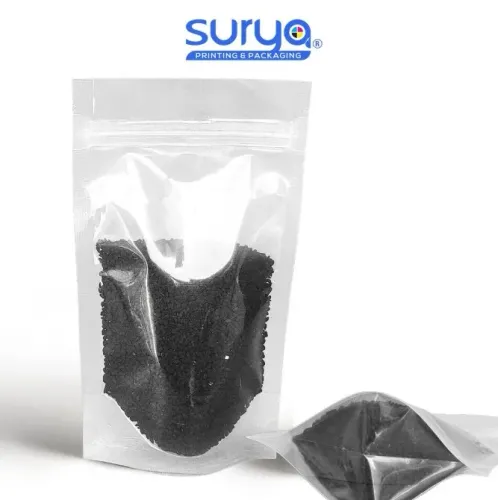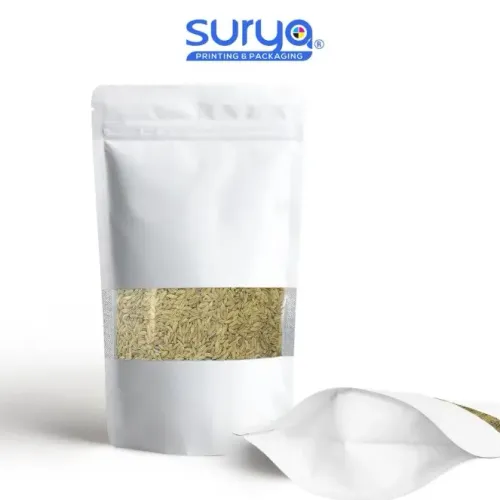
A transparent window can help shoppers judge quantity, colour and texture, but it also reduces the pouch’s opaque display area and can change its barrier performance. By comparing visibility, protection, filling practicality and test requirements, you can choose the format and specification that fit your product rather than choosing by appearance alone.
Key takeaways
- Choose a window when texture and fill level influence purchase decisions.
- Compare foil, PET, PE and barrier layers—not just the black exterior.
- Size the pouch around product volume, headspace and gusset geometry.
- Request seal tests, zipper samples and barrier specifications before approval.
When a window improves the pack—and when it weakens the presentation
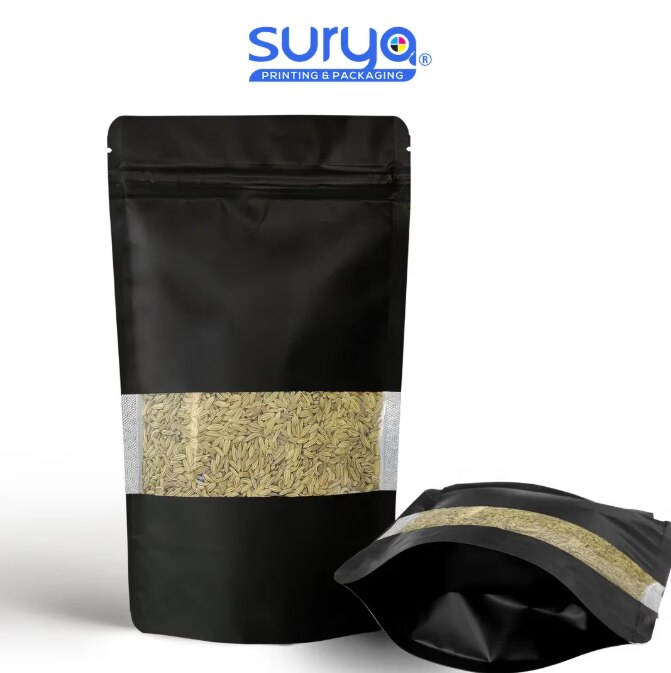
A window improves the pack when shoppers need to judge the contents before buying. Nuts, granola, dried fruit, tea, whole spices and colourful snacks benefit from visible texture and fill. Black window pouches also suit premium products whose appearance supports the price, provided the contents sit behind the viewing area at the intended fill level.
| Pack choice | Stronger presentation | Main drawback |
|---|---|---|
| Fully opaque black matte pouch | Light-sensitive products, powders, irregular pieces and contents that look dusty, broken or inconsistent | Shoppers cannot inspect the product |
| Black window pouch | Uniform snacks, attractive dried foods and products sold through visual appeal | Less printed area, reduced privacy and a window that can expose settling or uneven fill |
Choose a fully opaque black matte pouch for products harmed by light, such as some roasted foods, spices, oils or nutritionally sensitive ingredients, when the window would reveal an unattractive or variable mix. It also gives a cleaner luxury presentation and keeps the contents private.
For black window pouches, approve the window’s width, height, position and viewing side with the artwork. Keep it away from the bottom gusset and heat-seal zones; a registration shift can shrink the display area or expose seal contamination.
Confirm that the transparent film provides the needed protection, because its oxygen, moisture and light performance can differ from the surrounding laminate. A window is a selling feature only when the product remains visible after filling, settling and repeated handling.
Compare the complete barrier structure, not the black finish
A black matte surface tells you almost nothing about barrier performance. Compare the finished laminate and window construction, because black ink blocks visible light but does not reliably stop oxygen or water vapour.
| Feature | Black matte pouch | Window pouch |
|---|---|---|
| Light protection | High only when the structure includes a continuous foil or effective metallized layer; black pigment alone is not enough | The clear window usually transmits more light than the opaque panel, so compare total-light-transmission data for the complete pouch |
| Oxygen protection | Depends on PET/PE, metallized PET/PE, PET/foil/PE or another specified laminate | Depends on both the surrounding laminate and the window film; a strong outer structure cannot compensate for a weak window |
| Moisture protection | Comes from the sealant and barrier layers, not the matte coating | Compare the window’s WVTR with the opaque section and assess the assembled pouch, including seals |
For inner foil stand up pouches, request confirmation that the aluminium layer remains continuous after forming, filling and distribution simulation. Severe creasing can create pinholes or cracks, reducing protection.
Ask for finished-pouch OTR and WVTR results with units, test method, temperature, relative humidity, film thickness and specimen preparation. A bare number is not a valid supplier comparison; moisture conditions alone can change the result.
Choose metallized polyester when flex durability and lower material weight suit the target shelf life. Choose foil when maximum light, oxygen and moisture protection justifies the added material and handling requirements. For coffee, spices, nuts and snacks, require total-light-transmission data rather than judging protection by the black exterior.
Match pouch dimensions and gusset geometry to the product
A pouch must be sized for the product’s shape, density and fill weight, not selected from empty-pack dimensions. Fine powders need enough width for clean filling without trapping product in the zipper or seal; snacks need extra volume because irregular pieces bridge corners; coffee and dense granules need a stable base and controlled headspace.
| Product or pack condition | Dimension and window decision | Usability and shelf result |
|---|---|---|
| Powder or spice | Use a narrower body, a high window and enough headspace above the fill line | Reduces dust in the zipper and keeps the contents visible |
| Irregular snacks | Allow extra width and depth; place the window across the centre | Prevents pieces from hiding below the viewing area |
| Dense coffee or granules | Use a broad bottom gusset matched to the filled weight | Improves standing stability and prevents a top-heavy pack |
| Low fill weight | Reduce pouch height or lower the window | Avoids an empty-looking panel above the product |
Set the window’s width, height, viewing side and registration tolerance in the artwork. A window placed too low disappears behind the bottom gusset; one placed too high shows empty space. Keep it away from the zipper and heat-seal zones, where product dust or seal distortion can spoil the presentation.
Request filled samples at the intended weight. Check that the bottom gusset opens evenly, both bottom corners remain sealed, the pouch stands upright and the window faces forward after handling, drop testing and packing into the final carton.
Treat the zipper as a reseal feature and qualify the first seal
Do not treat the zipper as the package’s hermetic closure. For black matte ziplock pouches in coimbatore, specify a heat seal above the zipper as the first seal; the zipper provides repeated access after the consumer cuts or opens that seal.
Test production-filled pouches, not only empty samples. Run the same powder, snack, coffee, spice or other food product at the planned filling speed and fill weight.
- Check the zipper track for complete engagement after filling. Record opening force, reseal performance after repeated openings and the headspace lost to the zipper.
- Contaminate the upper seal area with realistic powder dust, then measure heat-seal strength and inspect for channels, wrinkles and incomplete film-to-film contact.
- Test the heat seal above the zipper for peel strength and leakage after filling, stacking, vibration and storage at the intended temperature.
- Open the tear notch by hand and confirm that it starts cleanly without ripping into the zipper, side seal or printed panel.
- Run the pouch through the filling line to check drop, alignment, zipper interference, sealing-jaw clearance and rejected packs.
A zipper that works on a clean sample can fail when spice powder or coffee fines sit in its track. Accept the pack only after filled-pouch leak testing and seal-strength results meet your written limits. Specify the zipper type, position, opening force and reseal-cycle target on the approved drawing.
What to request from a Coimbatore packaging manufacturer before approval
Before approval, require evidence tied to the exact laminate and artwork, not phrases such as “food grade,” “three-layer” or “high barrier.” A black matte pouches versus window pouches manufacturer in Coimbatore must identify whether the window uses the same barrier structure as the surrounding film.
Request these records from every supplier:
- The full bill of materials, film gauges, adhesive or extrusion-lamination system, sealant resin, ink position, food-contact layer and batch-traceability format.
- A finished-laminate food-contact declaration covering applicable Food Safety and Standards Authority of India requirements, plus migration test reports or certificates where applicable. “Non-toxic ink” alone is not sufficient.
- An artwork proof showing window size, viewing side, position and registration tolerance. Ask how much usable window remains after the stated tolerance.
- Filled-pouch trial samples from your production line, using the actual powder, snack, coffee or spice, fill weight and closure settings. Check filling contamination, heat-seal integrity, zipper engagement, tear opening, leakage, drop resistance and shelf standing.
| Evidence | Require on the report | Reject or query when |
|---|---|---|
| OTR | Units, temperature, relative humidity, method and thickness | A bare oxygen number is supplied |
| WVTR | Units, temperature, humidity, method and specimen preparation | Window and opaque areas are not identified |
| Seal performance | Seal strength, temperature, dwell time and pressure | Only the zipper is tested; the heat seal is absent |
| Window construction | Film structure and light-barrier result | The transparent area has no separate evidence |
A flexible packaging manufacturer in Coimbatore should provide retained trial samples and test records by lot. Surya Graphics should be assessed by the same document-and-trial checklist, rather than by finish or catalogue photographs.
Related products
 | Packaging Pouch Black Color Matte Finish transparent window Ziplock Inner Foil Stand-Up Pouch Appearance Matte Black in color | 3 sides sealed | Bottom gusset | Tear notch | Zipper | Inner foil | With window Technical Details Pet + Poly | 110... View product → |
 | Packaging Pouch Black Color Matte Finish Ziplock Inner Foil Stand-Up Pouch Appearance Matte Black in color | 3 sides sealed | Bottom gusset | Tear notch | Zipper | Inner foil | Without window Technical Details Pet + Poly |... View product → |
Frequently asked questions
When is a window pouch better than a black matte pouch?
Choose a window when shoppers need to see texture, colour, size or fill level before purchase. Nuts, granola, dried fruit, tea, whole spices and colourful snacks benefit from visibility.
Does a black matte finish provide the product barrier?
No. The finish is only the exterior appearance. Compare the complete laminate structure, including PET, PE, foil or other barrier layers, sealant and intended protection.
How should you choose pouch dimensions and gusset geometry?
Match the pouch to the product’s volume, density, shape and fill level. Check that the product sits behind the window and that the base gusset supports the filled pack.
What should you test before approving a zipper pouch?
Check zipper engagement, opening force, leak resistance and compatibility with the first heat seal. Request production samples and inspect seals after filling and handling.
Keywords