A gold matte finish tells you how the pouch looks, not how well it protects coffee, spices, snacks or moisture-sensitive goods. Before approving a retail pack, match the laminate and window to the product, confirm usable capacity and sealing performance, then check artwork, compliance and hot-humid transport conditions.
Key takeaways
- Request the complete laminate structure, not just the gold finish name.
- Match pouch dimensions and seal area to the product’s fill weight.
- Treat the zipper as reclosure; verify the primary heat seal separately.
- Approve artwork, window placement and mandatory retail information on one proof.
Confirm the Barrier Structure Behind the Gold Finish
Gold matte is an appearance, not a barrier specification. For gold matte pouches for retail products in Coimbatore, require the full laminate construction before approving colour: PET/PE, PET/metallized PET/PE, or PET/aluminium foil/PE. Gold ink on polymer film, gold-coloured metallized polyester and aluminium foil provide different protection against oxygen, moisture and light.
Ask the supplier to state:
- Each layer material, thickness or gauge, adhesive system and sealant layer
- Target oxygen transmission rate (OTR) and water-vapour transmission rate (WVTR), with test method and units
- Required light protection for the product’s fat content, aroma sensitivity, water activity and intended shelf life
- Barrier results after pouch forming, not only results for flat laminate
- Conditioning and test exposure for hot, humid storage and transport
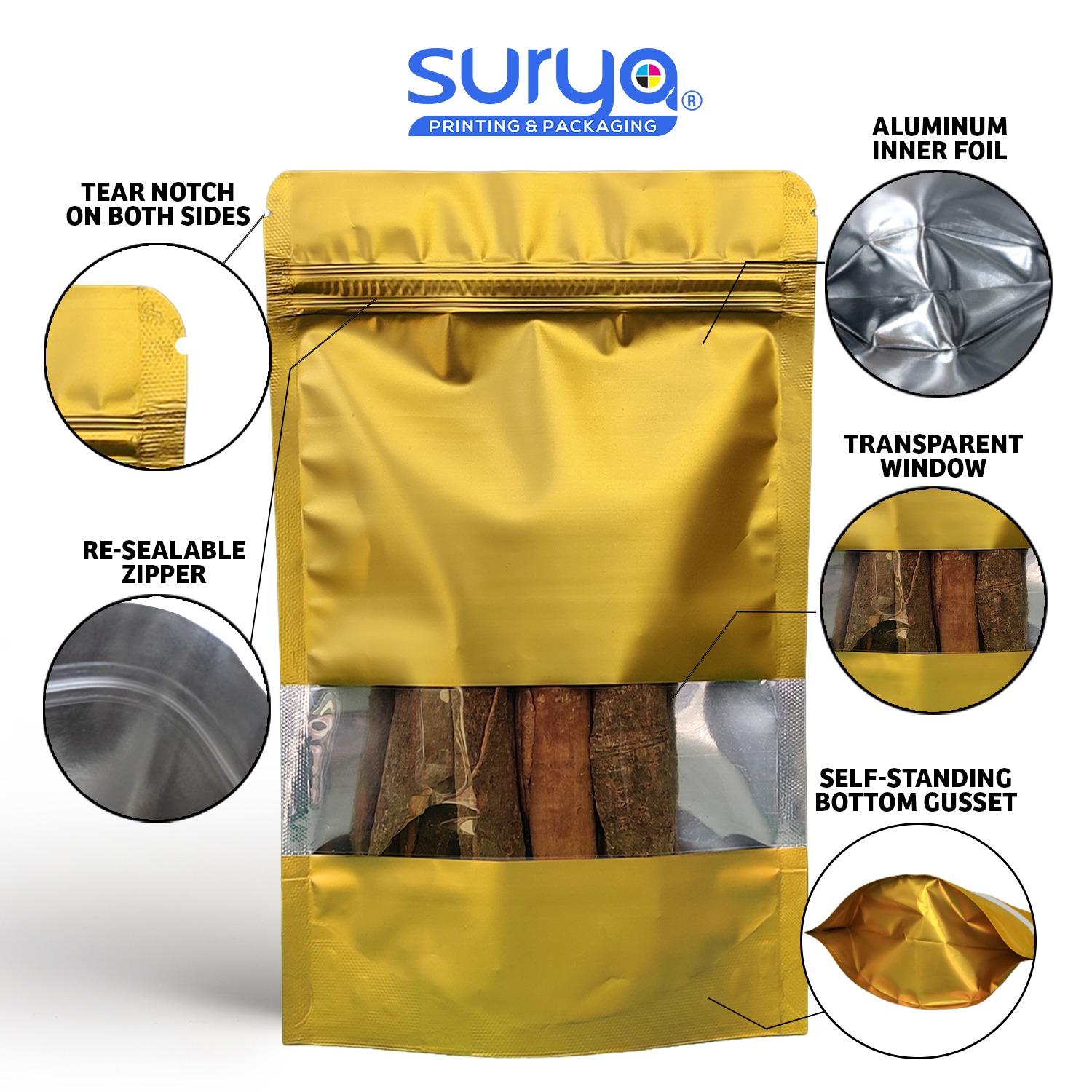
An inner foil stand up pouch places aluminium foil between polymer films and normally gives stronger gas and light protection than metallized polymer. It is not indestructible: sharp creases, repeated folding or rough handling can cause foil cracks and pinholes, so request the foil gauge and formed-pouch test results.
Do not treat “premium barrier” or “foil pouch” as measurable claims. If the pack has a transparent window, include its film, overlap and seal geometry in the barrier evaluation; the window interrupts the continuous foil or metallized layer.
Approve the gold finish with a production-substrate drawdown or press proof, because matte varnish, ink opacity and viewing light can make a screen image or Pantone reference misleading.
Match Pouch Size and Product Type to the Fill
A 250 g fill does not tell you whether a pouch is large enough. Calculate the product volume by dividing fill weight by bulk density, then add headspace for settling, expansion and clean sealing. A low-density snack needs more internal volume than a dense spice with the same weight.
Do not approve from nominal width and height alone. Bottom-gusset depth, seal width and the space occupied by the zipper reduce usable volume. Specify finished outside dimensions or usable internal dimensions, never both terms interchangeably, and approve a filled production-size sample standing on its gusset.
Headspace must leave enough room for the heat seal without trapping product in it. Powder that settles, coffee that releases gas, or snacks that break under compression each need a different fill trial.
An overfilled retail product packaging pouch may lean, wrinkle at the seal or burst during handling; excessive headspace wastes shelf space and makes the pack look underfilled.
Use the product’s behaviour to decide whether the format fits:
Product typeFit checkMain warningPowders and spicesNeed controlled filling and a clean seal zoneDust can weaken seal integritySnacks, dry fruits and pet treatsNeed gusset stability and crush clearanceSharp pieces can puncture the laminateCoffee, cosmetics and hygiene goodsNeed aroma, moisture or gas-management performanceA window can reduce light protection
A gold window ziplock pouch suits visible, dry products only after the window’s barrier and seal geometry pass testing. Choose a fully covered barrier pouch for light-sensitive goods.
Separate Zipper Reclosure from the Primary Seal
Approve the heat seal as the product closure; approve the zipper only as the reclosure feature. A zipper can close after opening, but it is not a hermetic barrier against oxygen, moisture or leakage. Keep a continuous heat-sealed band above the zipper and record its width in the specification.
1. Seal filled, production-size samples using the proposed machine settings. Measure heat-seal strength to ASTM F88/F88M, test seal-channel leakage with ASTM F1929 dye penetration, and check gross leaks with ASTM F2096 bubble testing. State the sample quantity and pass/fail limit before testing; visual seal appearance alone is not approval.
2. Open and close every zipper repeatedly, then inspect for incomplete engagement, crushed profiles, misalignment and slider separation. Test the zipper independently from the primary seal, because a smooth-running zipper does not prove seal strength.
3. Fill samples to the intended weight and headspace, hold them upright, invert them, and apply normal transport handling. Check for product escaping through the seal, zipper or corners, then repeat after conditioning at the planned storage temperature.
4. Confirm that the bottom gusset opens fully, bears the filled load and keeps the pouch upright without rocking. Approve finished outside dimensions or usable internal dimensions explicitly; nominal width and height alone do not define capacity.
Record the results against the exact retail product packaging pouch construction, zipper position, seal width and gusset depth. A gold matte finish can hide a weak seal, unstable base or zipper that is correctly printed but incorrectly placed.
Approve the Window, Artwork and Retail Information Together
A transparent window changes both the pack’s appearance and its protection. On a gold window ziplock pouch, approve the window position only after checking its overlap with the barrier laminate, seal area and printed graphics; a window can interrupt light, oxygen and moisture protection.
1. Mark the technical dieline in separate layers for the zipper, top seal, bottom gusset, tear notch, rounded corners, window boundary, registration marks and no-print or no-seal zones. Add the supplier’s registration tolerance. Without it, the gold graphic, window edge and zipper line can visibly drift.
2. Request a production-substrate drawdown or press proof, not only a screen image or Pantone reference. Compare the gold under the intended matte varnish, laminate opacity and retail lighting; matte surfaces can make gold appear duller, darker or less uniform.
3. Check the transparent window against the required oxygen transmission rate, water-vapour transmission rate and light protection for the product and shelf life. Include the window film, its overlap with the barrier laminate and its seal geometry in leak and barrier evaluation. Do not approve “premium barrier” as a specification.
4. Check the Indian retail panel for product identity, net quantity, manufacturer, packer or importer details, MRP, and applicable packing or date information such as packed-on and best-before details. Test contrast on the matte gold background and confirm the declaration panel remains readable after trimming.
Approve one combined artwork, dieline and physical colour proof. A visually attractive pouch can still fail production or retail release when the window, seals or mandatory information compete for the same space.
Run a Supplier Qualification Check for Coimbatore Conditions
Do not approve a supplier from a colour swatch alone. For a gold matte pouch in coimbatore, require evidence that the construction, barrier and seals will survive the product’s shelf life and hot-humid transport conditions.
Request this qualification pack before placing a production order:
- Documents: complete layer structure, such as PET/metallized PET/PE or PET/foil/PE; target OTR, WVTR and light-protection values; test methods and conditioning conditions; food-contact declaration; product specification; seal-strength and leak-test method; and batch-traceability format.
- Samples: production-substrate colour drawdown or press proof, unprinted pouches from the proposed laminate, filled samples at the intended weight, and samples conditioned at the agreed temperature, relative humidity and exposure time.
- Checks: verify pouch dimensions, bottom-gusset opening, film thickness, zipper alignment, tear-notch position, heat-seal width, seal strength, pinholes, odour, print registration and window clarity. Check the filled pouch for leaks after handling and compression.
Set acceptance limits before sampling. A Pantone reference or screen image cannot approve gold on a matte surface because ink, laminate opacity, varnish and viewing light change the result. Record whether the barrier report applies to the exact laminate, not a similar “premium barrier” film.
If Surya Graphics is being considered, ask for lot-specific documents and retain an approved physical sample as the incoming reference. Recheck each delivery for colour, dimensions, seal integrity and lot identity before filling gold matte pouches for retail products in coimbatore.
Related product
 Packaging Pouch
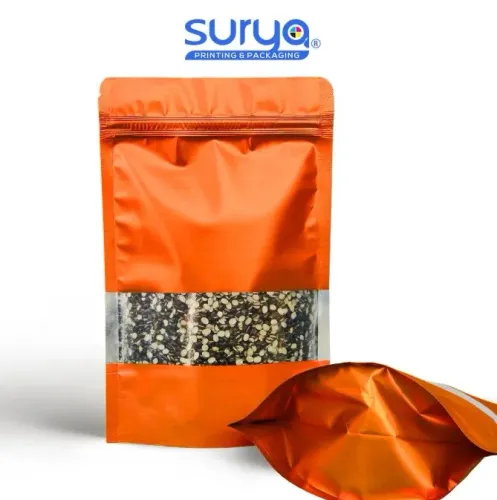
Gold Color Matte Finish transparent window Ziplock Inner Foil Stand-Up Pouch
Appearance Matte Gold in color | 3 sides sealed | Bottom gusset | Tear notch | Zipper | Inner foil | With window Technical Details Pet + Poly | 110...
Frequently asked questions
- What barrier structure should you check in a gold matte pouch?
- Ask whether the pouch uses PET/PE, PET/metallized PET/PE, or PET/aluminium foil/PE. Gold ink, metallized polyester and aluminium foil differ in protection against oxygen, moisture and light.
- How do you choose the right size for a retail product packaging pouch?
- Match the pouch width, height, gusset and usable fill volume to the product’s weight, bulk density and shape. Confirm that the fill will stay below the zipper and sealing area.
- Is a zipper the same as the pouch’s primary seal?
- No. A zipper provides reclosure after opening; the heat-sealed top or side seal provides the original closure. Approve and test both separately.
- What should you check before approving a gold window ziplock pouch?
- Review the window position, artwork registration, product visibility, zipper location and retail information together. Check that the window does not remove needed barrier coverage or interfere with the seal.
Keywords