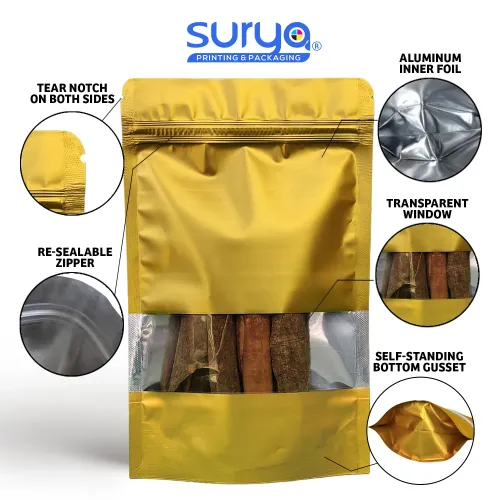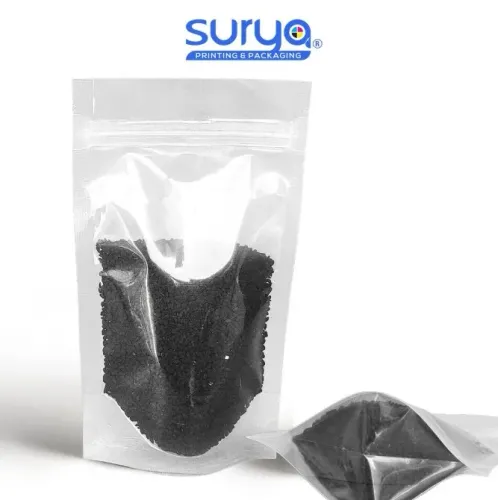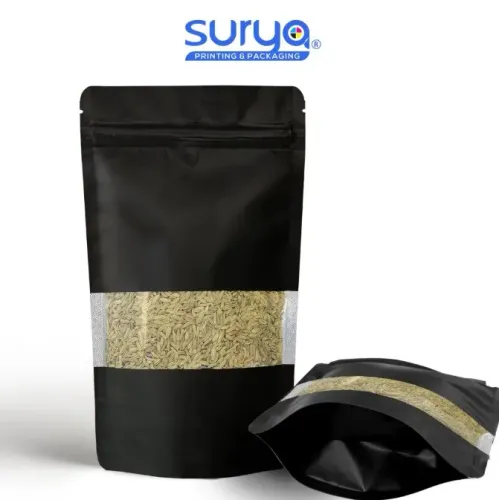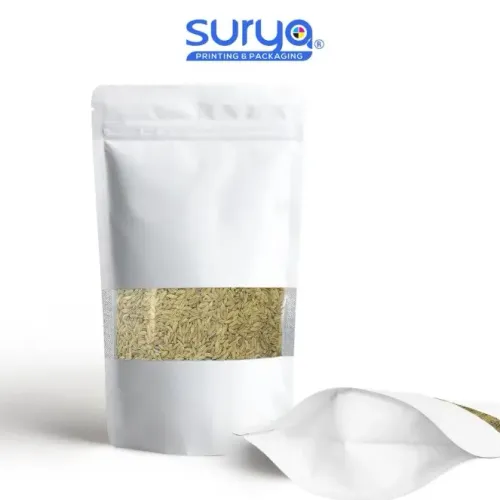
Choosing an orange pouch involves more than selecting a colour and nominal size. You need to match the pouch to the food, confirm usable capacity and standing stability, specify the laminate and barrier targets, then validate seals, print appearance and documentation before placing an order.
Key takeaways
- Test the filled pouch for stability; artwork alone cannot prove it will stand.
- Match laminate and sealant to moisture, oxygen, light and oil exposure.
- Request zipper, heat-seal and food-contact construction details in writing.
- Include product density, fill weight, dimensions and finish in your quotation request.
Which orange products suit this pouch format—and which do not?
Dried fruit, spice blends, roasted snacks, confectionery and free-flowing powders suit stand-up pouches when the laminate, sealant and closure match the product. An orange stand up pouches flexible packaging manufacturer in Coimbatore should test the filled pack, not approve it from artwork alone.
| Product | Pouch suitability | Main decision |
|---|---|---|
| Dried fruit | Good | Use moisture and oxygen barrier when colour, texture or aroma must last. |
| Spice blends | Good | Choose aroma-retaining film and keep powder away from the zipper and seal. |
| Roasted snacks | Good | Protect against oxygen and oil migration; test seal contamination from crumbs. |
| Confectionery | Good | Match the barrier to humidity, grease and aroma sensitivity. |
| Free-flowing powders | Conditional | Use a cleanable zipper or omit it when dust prevents reliable sealing. |
| Very oily foods | Conditional | Select a grease-resistant sealant; a rigid tub is safer for heavy oil release. |
| Sharp pieces | Conditional | Use puncture-resistant laminate; a carton or rigid container is safer if edges stress the film. |
Oil can weaken sealing, while sharp fragments puncture thin film. Dust lodged in the seal creates leaks, and moisture pickup turns crisp foods soft. Oxygen-sensitive products need metallised film or aluminium foil; aroma-sensitive products need tested retention. A wider zipper does not compensate for an unsuitable barrier or contaminated seal.
“Food grade” only addresses stated contact conditions for the construction. It does not prove suitability for your product, oxygen level, moisture exposure or intended shelf-life period. Request declarations for ink, adhesive, films, sealant, zipper and foil, plus barrier data under stated test conditions.
How do you choose the pouch size and prove that it will stand when filled?
Choose usable capacity, not the catalogue size. Your dimensional drawing must show overall width and height, bottom-gusset depth, seal width, zipper-to-top-seal distance, finished fill height and tolerances. A pouch’s nominal dimensions include seals, rounded corners and gusset folds, so they do not equal the space available for product.
| Nominal measurement | What changes in use | What to record |
|---|---|---|
| Overall width and height | Seals and folds reduce usable area | Finished dimensions and fill height |
| Bottom-gusset depth | Controls base opening and upright stability | Gusset depth, seal placement and laminate stiffness |
| Product volume | Bulk density converts mass into volume | Fill mass, density and target volume |
| Headspace | Prevents product from reaching the zipper or top seal | Headspace above the settled product |
| Angle of repose | A sloping powder or granule surface reduces effective fill height | Product angle and settled fill profile |
Your brief to an orange stand up pouches flexible packaging manufacturer in coimbatore should specify the actual product, fill mass, bulk density and required headspace. Test production samples, not empty pouches or a different filler.
- Fill the pouch at target mass, allow the product to settle, and check base opening.
- Confirm the pouch remains upright after lifting, placing, vibration and repeated handling.
- Check tipping and fit inside the intended carton, including clearance at the zipper and top seal.
- For powders, inspect whether product reaches the zipper and whether dust or oil contaminates the seal area.
- Record dimensions, fill height and failures before approving the size.
What do the laminate, matte finish, window and inner foil actually do?
PET or BOPP gives the pouch a printable, stiff outer surface; PE provides the heat-sealing layer and product-contact surface. Metallised film reduces light and gas transmission, while aluminium foil gives stronger protection against oxygen, moisture, light and aroma loss. “Inner foil” alone is not a complete specification for inner foil flexible pouches.
| Layer | Main job | What to specify |
|---|---|---|
| PET or BOPP | Printability, stiffness, scuff resistance | Film type, gauge, print side and finish |
| PE | Heat seal, flexibility and food contact | Sealant resin, gauge and seal range |
| Metallised film | Light and barrier improvement | Metallisation grade and target performance |
| Aluminium foil | Highest light, oxygen and aroma barrier | Foil gauge, pinhole control and laminate order |
Ask for oxygen transmission rate (OTR) and water-vapour transmission rate (WVTR) targets with test conditions, not simply “high barrier.” ASTM D3985 measures oxygen transmission with a coulometric sensor; ASTM F1249 measures water-vapour transmission with a modulated infrared sensor. State temperature, relative humidity, conditioning and reporting units, because results are not comparable without them.
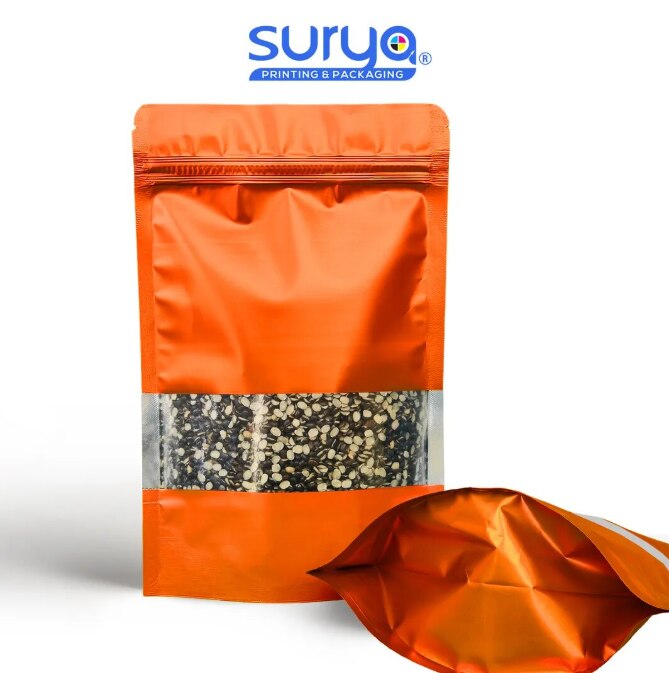
A window stand up packaging design trades visibility for barrier protection: the clear section interrupts the opaque or metallised structure. Define its film, exact location and area. A large window can increase light, oxygen and moisture exposure.
Printed orange colour, orange-coloured film and a matte coating are different choices. Orange matte ziplock pouches need approval from a laminated-film press proof, which shows final colour, gloss and layer interaction more reliably than a screen image or paper proof.
How should you validate the zipper, heat seal and food-contact construction?
A zipper provides reclosure; it does not replace a hermetic heat seal. For orange matte ziplock pouches, require a continuous seal above or around the zipper, then validate the finished pack rather than trusting the zipper track.
- Specify the seal width and inspect filled pouches for powder, oil, crumbs or product trapped in the seal. Contamination can create channels that leak during transport, even when a clean laboratory seal looks strong.
- Measure seal strength using ASTM F88/F88M and check gross leaks with ASTM D3078 bubble-emission testing. Run these tests on production-made, filled pouches, not only flat film samples.
- Establish the heat-seal window on the actual machine: seal-initiation temperature, dwell time, jaw pressure, jaw alignment, jaw cleanliness and sealant resin. ASTM F2029 can support laboratory heat-seal preparation, but settings cannot transfer between suppliers simply because both quote the same nominal film thickness.
- Approve samples after filling, closing and handling. Include drop or vibration transport simulation, zipper operation after sealing, seal appearance, leaks and pouch opening.
Request construction-level food-contact declarations for the ink, adhesive, outer film, sealant, zipper, aluminium foil and coatings. A “food-grade film” statement does not cover every layer or prove suitability for your food, process and storage conditions. Keep the declarations with the approved laminate specification and test report.
What should you put in a quotation request to a Coimbatore manufacturer?
Send a drawing and construction schedule, not only artwork. Ask each flexible packaging manufacturer in coimbatore to quote the same filled dimensions, material and tests. Surya Graphics is one local supplier to approach for a construction-specific discussion, sample fit trial and physical print approval.
Include these items in the request:
- Layer order, such as PET/foil/PE, with each film gauge or GSM, total thickness and sealant resin.
- Barrier class, target OTR and WVTR, test conditions, and ASTM D3985 and ASTM F1249 results where applicable.
- Overall size, usable fill height, bottom-gusset depth, window width and height, and dimensional tolerances.
- Matte film or coating, zipper type, zipper position, seal width, tear-notch location and print side.
- Orange colour standard, such as an approved Pantone reference or physical press proof; do not approve from a screen.
- Food-contact declaration covering ink, adhesive, films, foil, sealant, zipper and coatings.
- Seal-strength, gross-leak, transport and fit-trial requirements, including ASTM F88/F88M and ASTM D3078 where relevant.
Compare quotations by construction, not appearance:
| Item | Comparable quote | Warning sign |
|---|---|---|
| Laminate | Same layer order, gauges and barrier targets | “110 microns” only |
| Window | Same position, area and film | Window added without barrier review |
| Validation | Same tests, tolerances and sample quantity | Artwork proof only |
For an orange stand up pouches flexible packaging manufacturer in coimbatore, identical orange artwork does not prove identical performance. A window can weaken light and barrier protection, while matte finishes alter colour and scuff resistance.
Related product
 | Packaging Pouch Orange Color Matte Finish transparent window Ziplock Inner Foil Stand-Up Pouch Appearance Matte Orange in color | 3 sides sealed | Bottom gusset | Tear notch | Zipper | Inner foil | With window Technical Details Pet + Poly | 110... View product → |
Frequently asked questions
Which orange products suit stand-up pouches?
Dried fruit, spice blends, roasted snacks, confectionery and free-flowing powders suit the format when the laminate, sealant and closure match the product. Products that leak, release gas or require rigid protection need a different construction or additional testing.
How do you prove that a pouch will stand when filled?
Fill production-intent samples to the target weight, seal them, place them on the intended retail surface and check their base width, balance and resistance to tipping. Approve the filled pack rather than relying on artwork or an empty sample.
What do laminate, matte finish, window and inner foil do?
The laminate supplies barrier and mechanical layers, the matte finish changes appearance and handling, the window displays the contents, and inner foil reduces light and oxygen transmission. Select each feature against the product's moisture, oxygen, light and oil sensitivity.
What should you validate before approving the zipper and heat seal?
Check that the zipper opens and recloses cleanly, the heat seal is continuous at the target sealing conditions, and the food-contact layer is identified in the construction documents. Test filled samples for leaks, channel defects and contamination in the seal area.
What belongs in a quotation request to a Coimbatore manufacturer?
State the product, fill weight, bulk density, pouch dimensions, closure, finish, window or foil requirement, artwork status, order quantity, delivery location and required tests. Ask for the laminate structure, sealant, food-contact documentation, sample process and printing specifications.
Keywords