A pouch that looks premium on a shelf can still fail when oil contaminates its seal, moisture softens a dry mix, or freezing cracks the laminate. By the end, you will be able to match a pouch structure to the food and process, specify dimensions and testing, brief the artwork correctly, and compare supplier proposals without relying on appearance or unit price alone.
Key takeaways
- Match barrier layers to moisture, oil, oxygen and freezing conditions.
- Test seals with the actual fill weight and food residue.
- Use windows, zippers and matte finishes to support real shopper decisions.
- Compare suppliers on testing, compliance documents, tooling and total delivered cost.
Match the pouch structure to the food, storage and cooking process
1. Start with the food and process, not the artwork. Dry mixes and spice blends need water-vapour and aroma protection; oily marinades need grease resistance and seal contamination tolerance; gravies need liquid-tight seals and chemical compatibility; frozen components need low-temperature toughness, puncture resistance and flex-crack resistance.
Moisture-sensitive ingredients also need oxygen and water-vapour data at the intended temperature and relative humidity.
2. Treat “white matte” and “110 microns” as appearance and thickness descriptions, not a specification. Request the finished laminate’s oxygen transmission rate, water-vapour transmission rate, aroma barrier, grease resistance, light protection, puncture resistance and low-temperature performance. Ask for the exact layer structure, including sealant, adhesive, ink, barrier layer and thickness.
Aluminium foil provides a continuous metal barrier; metallised film is polymer coated with a thin metal layer and is not equivalent.
3. Do not assume conventional ready to cook pouches suit hot filling, pasteurisation, retort, boiling, microwave use, chilled storage or freezer storage. Each process needs validation at its actual temperature, pressure, time and storage condition, including seals, zipper, adhesive, ink and delamination. A conventional white matte pouch may fail even when its film looks intact.
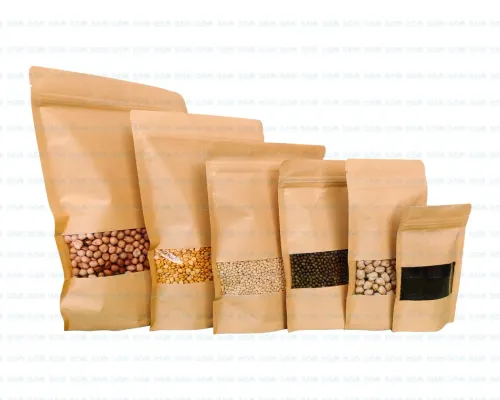
4. Choose the format around handling. Use a rigid tray for a shaped meal component or high puncture risk, a carton for dry mixes needing stacking and print area, a flat pouch for compact dry products, and a centre-seal pouch for efficient packing.
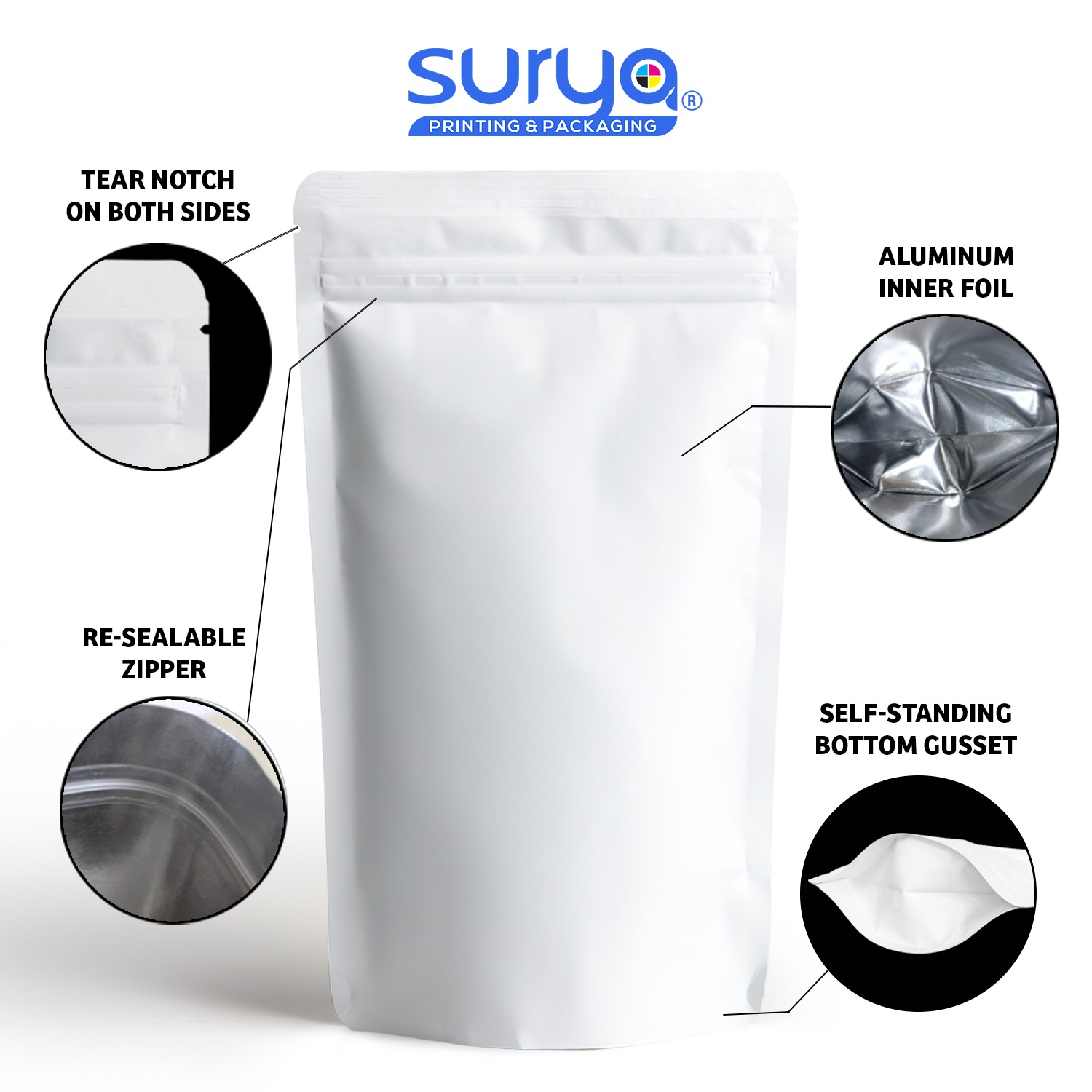
Choose kraft only after confirming its barrier structure; choose a no-gusset pack for light fills. A gusseted stand-up format suits heavier or liquid products, but adds corner stress. White matte printed packaging pouches for ready to cook food work only when the complete construction matches the product, route and cooking method.
Size, fill weight and seals determine whether the pack survives handling
Choose dimensions from measured bulk density and target fill weight, then validate the filled pack on its actual distribution route. A white matte stand up pouch or white ziplock food pouch that fits the empty product can still overfill, topple, or burst after filling.
Measure headspace at the target weight, not by eye. Keep powder, oil and sauce away from the zipper and heat-seal area; specify clearances for the zipper, seal width and tear notch so filling equipment does not cut or seal through them.
Nominal capacity is not usable capacity:
Nominal capacityWhat it meansWhy it misleadsFlat pouch sizeFilm dimensions before formingExcludes seals, gusset folds and headspaceBottom-gusset capacityVolume created when the gusset opensCorners consume space and add stressUsable fill capacityProduct volume at the target weight and stable shapeThe figure that matters on the filling line
Filled pouches accelerate, separate and stand differently on automated equipment. Gusset corners concentrate stress under stacking and compression; courier drops, retail handling and repeated opening can cause corner leaks, gusset cracking or delamination even when a flat seal passes.
Validate the primary perimeter heat seal separately from the resealable zipper: the zipper is a convenience feature, not the original tamper-evident closure. Test filled packs for:
- Seal strength and contamination tolerance with powder, oil and sauce
- Leak resistance, drop impact, compression and flexing
- Zipper function after repeated opening
- Corner and gusset failure after distribution simulation
Use the window and matte print as functional design decisions
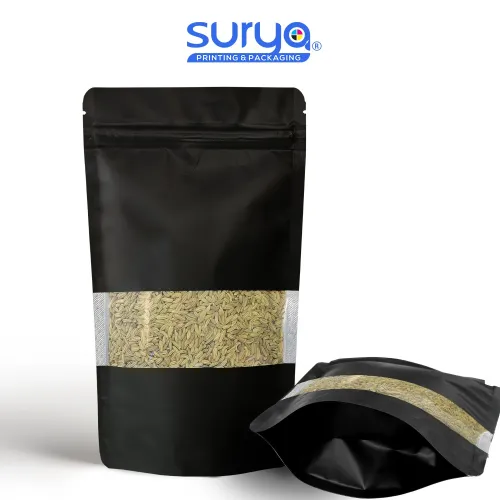
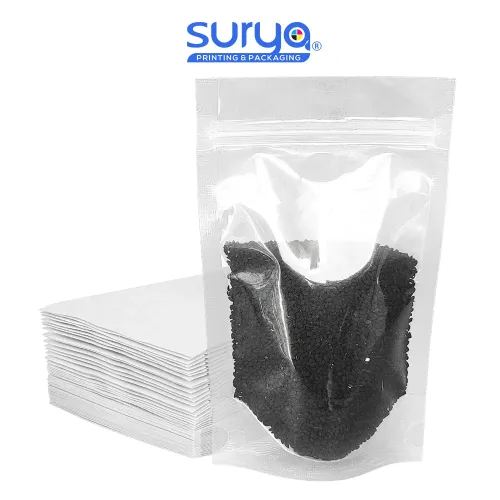
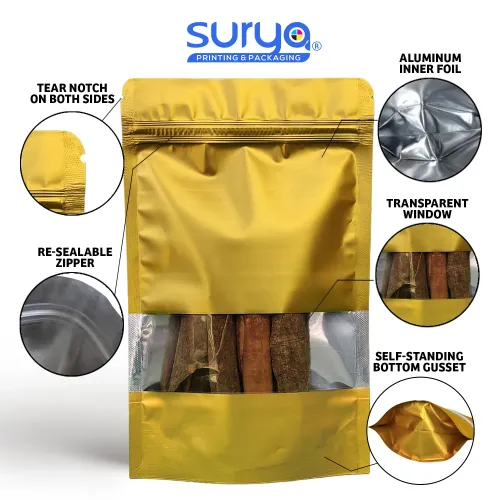
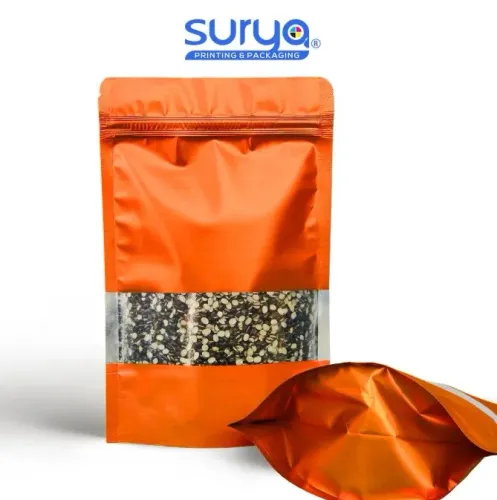
A white window packaging pouch helps sell a ready-to-cook product when shoppers need to see spice pieces, vegetables or colour before purchase. It weakens protection when light-sensitive ingredients, long shelf life or rough automated handling matter.
FeatureTransparent windowOpaque panelLightMore exposure; test photostabilityStronger light protectionBarrierClear film or missing white layer can change oxygen and moisture transmissionDo not assume the same barrier across the packStiffness and sealsDifferent flex, seal contamination and seal strength may resultMore uniform constructionProduct visibilityShows colour and pieces, including defectsHides appearance but protects presentation
Specify the window film, dimensions, position and complete-construction oxygen transmission rate and water-vapour transmission rate. Do not copy barrier data from the opaque panel.
Matte film reduces glare and can hide minor scuffs; glossy film usually gives brighter colour reproduction and clearer contrast. Matte surfaces need tested ink adhesion, barcode contrast, condensation behaviour and machine coefficient of friction because drag can disrupt feeding; gloss can reveal scratches and reflections can impair scanning.
Approve artwork only after checking:
- Reverse or surface printing, ink system, colour profile and rub resistance
- Barcode quiet zone, variable-data area and batch-coding method
- Zipper, tear notch, gusset, seal clearance and primary heat-seal zone
- Ingredients, allergens, net quantity, nutrition, symbols, dates, storage and cooking instructions
Reserve that information before enlarging the window. A visible product cannot compensate for an unreadable label or unreliable seal.
Validate food safety, consumer instructions and production compatibility
1. Before commercial filling, obtain a food-contact declaration for every applicable film, sealant, adhesive, ink, coating and zipper component. Request migration or compliance documentation tied to the exact laminate, adhesive system, food type, fill temperature, storage condition, shelf life and cooking method—not a generic material certificate.
2. Approve a physical or digital proof, then run a filled-line trial using the real product, fill weight, headspace, machine speed and closure settings. Complete production validation after the trial; artwork approval or an empty sample pouch does not prove that ready to cook pouches will run reliably or protect food.
3. Document the primary heat-seal specification separately from the zipper: seal width, jaw temperature, dwell time, pressure and acceptable powder, oil or sauce contamination. After filling, inspect seals visually and test contaminated samples for seal strength, channel leaks and overall leak resistance at the worst-case production condition.
The zipper provides resealing, not the original hermetic closure.
4. Print instructions that tell consumers to cut at the tear notch without damaging the zipper, reseal after opening and follow the stated storage direction. State water quantity, cooking time, serving size, thawing requirement, refrigeration or freezing requirement in measurable terms.
Confirm variable printing can add the batch number, manufacture or packing date, best-before date and MRP legibly on every production run.
Compare supplier proposals beyond the quoted price
A low unit price can hide a large minimum order, long lead time, or costly freight. Compare each proposal against your actual fill weight, sales forecast and filling line before choosing white matte printed packaging pouches for ready to cook food.
Proposal itemAsk forCommercial riskStock and productionStocked or made-to-order; dimensions and fill weightsStock reduces lead time; custom sizes increase commitmentPrinting and toolingPrint configuration, cylinder or plate charges, setup fees and proofingTooling can outweigh a lower pouch priceSupply termsMinimum order, lead time, wastage allowance, repeat-order consistency and freightA cheap first run can become expensive to replenish
Your quotation checklist should also confirm:
- Machine-ready dimensions, zipper position, seal width and variable-data method
- The laminate specification, food-contact declaration, barrier data and validation plan
- Charges for artwork changes, physical proofs, sampling and filling trials
- Whether quoted wastage includes startup rejects and colour matching
The practical workload is substantial: finalise the product specification, create artwork, approve a proof, run a filling trial, test filled packs, then document the approved laminate and seal temperature, dwell time, pressure and contamination tolerance. A buyer speaking with Surya Graphics can request these records rather than accepting “white matte” as the specification.
Do not treat PET, foil, poly laminates and mono-polyolefin as interchangeable. Ask whether the structure is accepted in your intended collection stream, whether layers can be separated or recycled, and which disposal instruction belongs on the pack.
A mono-polyolefin white matte stand up pouch may simplify recycling, but only if it still delivers the required barrier, seal, puncture and shelf-life performance.
Related products
 Packaging Pouch
White Color Matte Finish Ziplock Inner Foil Stand-Up Pouch
Appearance Matte White in color | 3 sides sealed | Bottom gusset | Tear notch | Zipper | Inner foil | Without window Technical Details Pet + Poly |...
View product → Packaging Pouch
White Color Matte Finish transparent window Ziplock Inner Foil Stand-Up Pouch
Appearance Matte White in color | 3 sides sealed | Bottom gusset | Tear notch | Zipper | Inner foil | With window Technical Details Pet + Poly | 110...
Frequently asked questions
- How do you match a pouch structure to ready-to-cook food?
- Use water-vapour and aroma barriers for dry mixes, grease resistance for oily marinades, liquid-tight seals for gravies, and low-temperature toughness for frozen components.
- What determines whether a ready-to-cook pouch survives handling?
- Pouch dimensions, fill weight, material thickness, seal width, seal strength and resistance to puncture or flex cracking determine handling performance.
- When should you choose a white window packaging pouch?
- Choose a window when shoppers benefit from seeing the product, but confirm that the exposed area does not weaken barrier protection or reduce print space for instructions.
- What should you validate before approving printed food pouches?
- Validate food-contact documentation, batch traceability, consumer cooking instructions, seal performance, filling-machine compatibility and storage-condition performance.
- How should you compare ready-to-cook pouch suppliers?
- Compare material structure, testing evidence, minimum order quantity, cylinder or plate costs, lead time, wastage, compliance documents and delivered cost rather than price alone.
Keywords